Free Renovation Quotation Template (Malaysia) + How to Use It
Published
A good renovation quotation lists every piece of work by trade (hacking, tiling, carpentry, electrical and so on), with a unit, quantity and rate for each line. It also states what’s excluded, how long the price is valid, and when each payment is due. Below is a free Excel template built that way for Malaysian contractors and interior designers, plus how to fill it in without underquoting.
Download the free template (.xlsx)
Works in Microsoft Excel, Google Sheets (File → Import) and Apple Numbers. No sign-up needed.
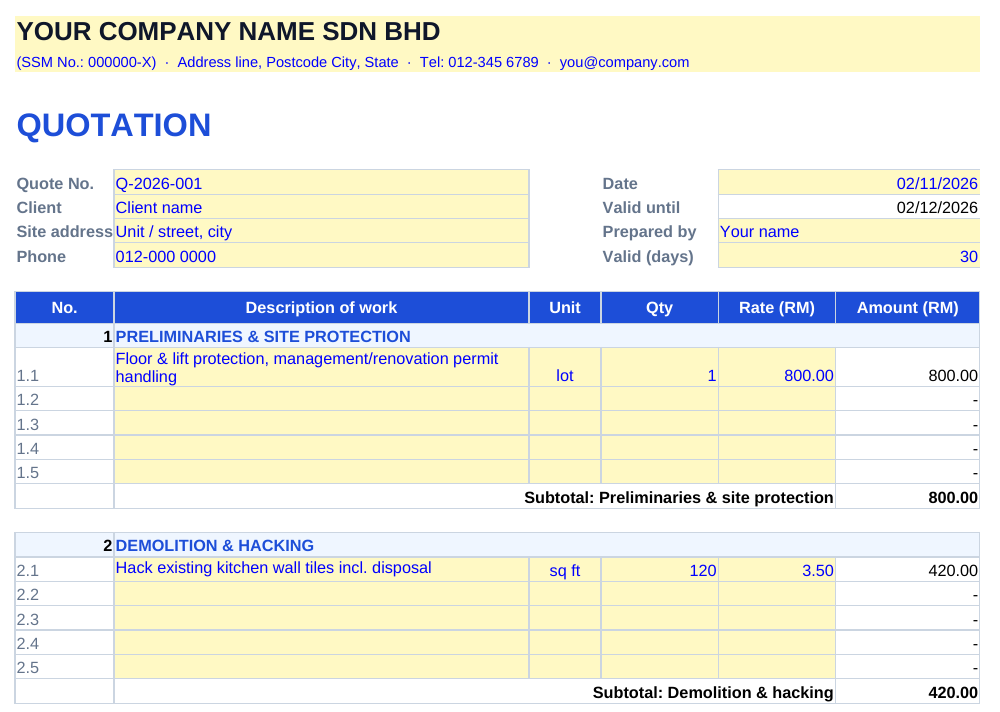
What’s in the template
- Letterhead and quotation details: company name, SSM number, quote number, client, site address and an automatic “valid until” date.
- 10 trade sections: preliminaries & protection, demolition & hacking, masonry & waterproofing, tiling, plaster ceiling, electrical, plumbing, carpentry, painting, and cleaning & disposal. Each section has five lines and its own subtotal.
- Automatic totals: Amount = Qty × Rate, plus section subtotals, discount, service tax and the grand total.
- Service tax line: set to 0% by default. Change it only if you’re SST-registered and the work is taxable (see below).
- Payment schedule: five milestone payments that must add up to 100%. The sheet warns you if they don’t.
- Terms & conditions and an acceptance block for the client’s signature.
Yellow cells are for you to fill in. White cells calculate automatically. The first line in each section is an example only: replace the illustrative quantities and rates with your own.
What a professional renovation quotation should include
- Who you are. Registered company name, SSM number, address and a contact person. With renovation scams in the news, showing you’re a registered business is the quickest way to earn trust.
- Who and where. The client’s name and the exact site address, including unit number.
- Itemised work, grouped by trade. “Kitchen renovation – RM28,000” invites arguments. “Supply & lay 600 × 600mm homogeneous floor tiles, 450 sq ft @ RM11” doesn’t. Lump-sum quotes with no breakdown are one of the first red flags homeowner guides warn about.
- Unit, quantity and rate on every line. This is what lets you re-measure fairly and price variations consistently later.
- Exclusions. Say what’s not included: loose furniture, appliances, light fittings, management deposits, authority fees.
- Validity period. Material prices move. A clear “valid for 30 days” protects you.
- A payment schedule tied to milestones, not dates.
- Terms: how variation orders are handled, the defects liability period, who handles renovation permits, and the estimated duration.
- Acceptance. A line for the client to sign, which turns your quotation into an agreement.
How to price each line without losing margin
Most underquoting doesn’t come from bad rates. It comes from missing lines and confusing markup with margin.
Lines contractors commonly forget:
- Floor, lift and corridor protection, plus renovation permit handling with the management
- Debris disposal and lorry trips
- Waterproofing before tiling in wet areas
- Making good after hacking (plastering and skimming)
- Final cleaning before handover
- Wastage allowance on tiles and boards (cut pieces, breakage)
Markup vs margin. If an item costs you RM100 and you add a 30% markup, you sell at RM130, but your margin is only 23% (RM30 ÷ RM130). To earn a true 30% margin you need:
| Formula | Selling price on RM100 cost | |
|---|---|---|
| 30% markup | cost × 1.30 | RM130.00 |
| 30% margin | cost ÷ (1 − 0.30) | RM142.86 |
On a job that costs you RM50,000, that’s the difference between quoting RM65,000 and RM71,429, more than RM6,000. Decide which one you mean, and apply it the same way on every line.
Should you add SST to a renovation quotation?
Since 1 July 2025, construction work has been a taxable service at 6% in Malaysia. Two conditions mean most small renovation contractors still don’t charge it:
- Only registered contractors charge it. Registration is required once your taxable construction services exceed RM1.5 million in 12 months.
- Residential buildings are excluded. Construction work on residential buildings falls outside the tax, and Service Tax Policy 2/2026 (issued June 2026) confirms the exemption for work on completed residential buildings, backdated to 1 July 2025. To rely on it, the contractor must keep proof that the building is residential, and the invoice must show the client’s name and the property address.
Commercial fit-outs (offices, shops, F&B) are a different story: if you’re SST-registered, they’re generally taxable. Leave the template’s tax rate at 0% unless you’re registered and the job is taxable. The rules changed twice in a year, so confirm with your tax agent or the Royal Malaysian Customs Department.
A payment schedule homeowners will trust
Homeowners in Malaysia are wary of renovation scams, and the deposit is where trust is won or lost. Homeowner guides describe a 10–20% deposit as normal and treat more than 25% upfront as a red flag. The template’s default schedule follows that:
| Stage | Milestone | % |
|---|---|---|
| 1 | Deposit upon confirmation | 20% |
| 2 | Hacking, masonry & wet works completed | 30% |
| 3 | Carpentry, electrical & plumbing installed | 30% |
| 4 | Completion & handover | 15% |
| 5 | Retention, released after the defects period | 5% |
Tie each payment to something the client can see on site. That gets you paid faster, and it gets you paid with fewer arguments.
Common quotation mistakes
- No validity date, so a client comes back six months later expecting the old price.
- “Any changes, settle later.” Put variation orders in writing with a price before doing the work.
- Rounding everything into lump sums, which makes every change a negotiation.
- Sending the spreadsheet itself. Export to PDF so the client can’t edit your figures.
- Re-typing old quotations for similar jobs and missing a line along the way.
When a spreadsheet stops being enough
Excel works well for a few quotations a month. It gets painful when you’re revising quotes several times, keeping track of which version the client saw, or checking margin line by line (see how the options compare). QCON is built for that: the same section-by-section structure, cost vs selling price on every line, automatic margins, and a professional PDF with your branding in minutes.
Sources
- Grant Thornton Malaysia, Revision of sales tax rates and expansion of scope for service tax (2025)
- Landco, SST on construction services, registration threshold and residential exclusion
- Lookuptax, Service Tax Policy 2/2026: construction on completed residential buildings
- Qanvast, What to look out for before signing a renovation contract
- Recommend.my, How to avoid renovation scams in Malaysia
Frequently asked questions
- What should a renovation quotation include in Malaysia?
- Your company details and SSM number, the client and site address, the work itemised by trade with unit, quantity and rate, what is excluded, how long the price is valid, a payment schedule tied to milestones, terms for variations and defects, and a space for the client to sign.
- How much deposit should a renovation contractor ask for?
- Malaysian homeowner guides treat a 10–20% deposit as normal and flag anything above 25% upfront as a warning sign. Link the remaining payments to visible milestones and hold back a small retention, such as 5%, until defects are fixed.
- Do renovation contractors charge SST in Malaysia?
- Since 1 July 2025 construction work is taxable at 6%, but only SST-registered contractors (more than RM1.5 million of taxable construction services in 12 months) charge it, and work on residential buildings is excluded. Most small contractors renovating homes don't charge SST. Check with your tax agent for commercial work.
- How long should a renovation quotation be valid?
- Long enough for the client to decide, but short enough that material prices won't move much. 30 days is a common choice, and it's the template's default. State the period clearly so an old quote can't be held against you.
- What is the difference between markup and margin?
- Markup is profit as a percentage of cost; margin is profit as a percentage of the selling price. On an item that costs RM100, a 30% markup gives RM130, but a 30% margin needs RM142.86 (cost ÷ 0.70).