Variation Order Template (Malaysia) for Renovation Contractors
Published
A variation order (VO) is a signed, written change to the original quotation: work added, work omitted, or work changed. It states the price of the change, the revised contract sum and any extra time, and the client signs it before you do the work. Below is a free Excel variation order template for Malaysian renovation contractors and interior designers, and how to use it so changes don’t eat your margin.
Download the free VO template (.xlsx)
Works in Microsoft Excel, Google Sheets (File → Import) and Apple Numbers. No sign-up needed.
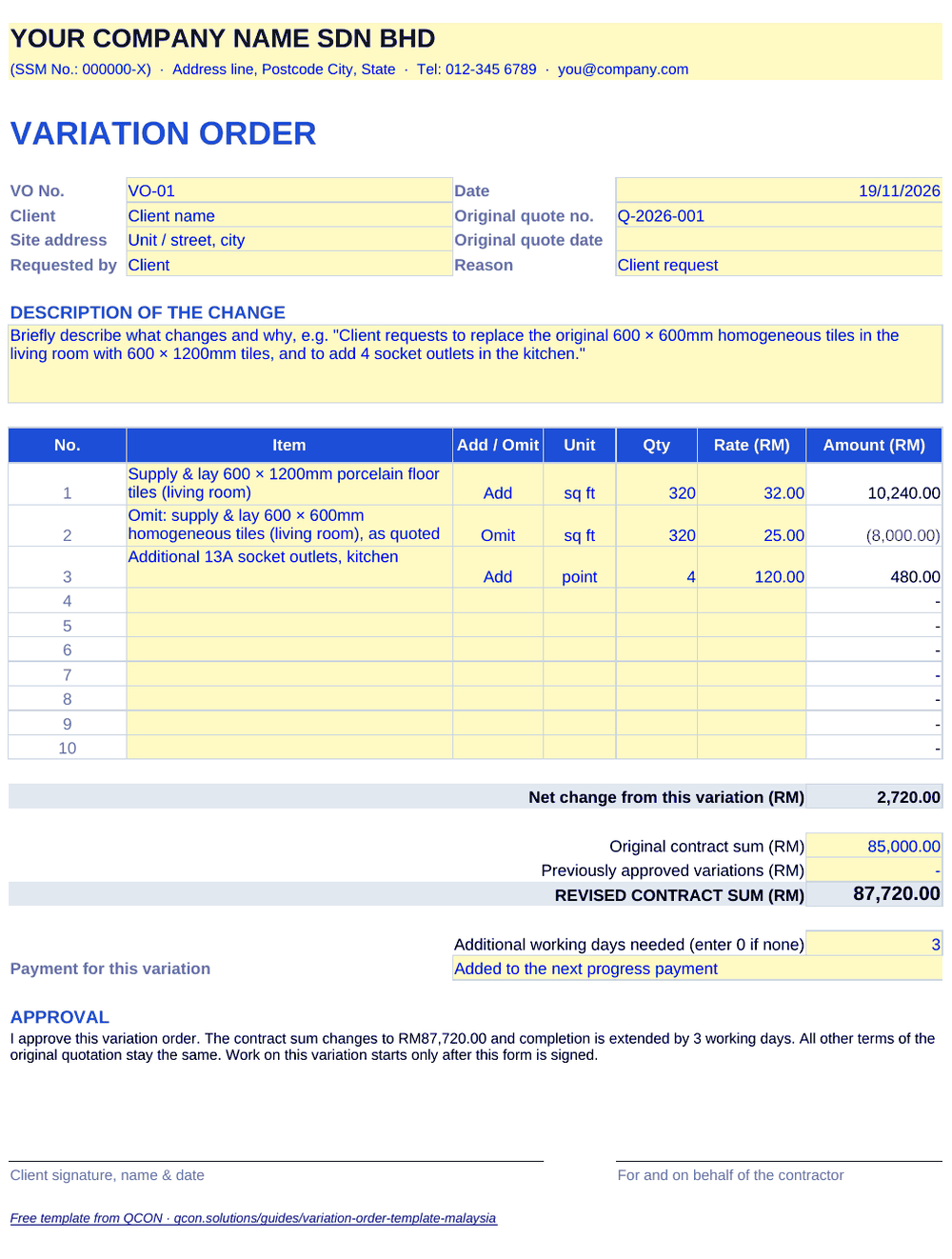
What’s in the template
- VO details: VO number, date, client, site address, the original quotation number and date, who asked for the change, and why.
- Description of the change, in plain words the client will understand.
- Up to 10 items, each marked Add or Omit. Omissions are credited automatically and shown in brackets.
- Net change, previously approved VOs and the revised contract sum, calculated for you.
- Extra working days and payment terms for this variation.
- An approval block that writes out the new contract sum and the time extension in words, with a line for the client’s signature.
- A VO Register sheet that logs every variation on the job, with the approved total and the current contract sum.
Yellow cells are for you to fill in. White cells calculate automatically. The first lines are examples only.
Why “add first, settle later” costs you money
Changes are normal in renovation: the client sees the tiles laid and wants bigger ones, the hacking uncovers a leaking pipe, or the designer moves a socket. The problem isn’t the change. It’s agreeing on the price after the work is done, when you have no leverage left. A signed VO before the work:
- fixes the price while the client still has a choice;
- records the extra time, so a later handover isn’t counted against you;
- keeps the contract sum current, so the final bill has no surprises for either side.
CIDB’s standard Contract for Renovation and Small Projects follows the same principle: instructions must be dated and in writing, and varied work is valued at the contract rates, or at fair market rates where there is no contract rate.
How to fill in a variation order
- Number it and link it to the quotation. VO-01, VO-02 and so on, with the original quote number and date, so anyone can trace the change back.
- Describe the change in one or two sentences. “Replace the 600 × 600mm living room tiles with 600 × 1200mm tiles, and add 4 sockets in the kitchen” is better than “tiles change”.
- List each item as Add or Omit. A substitution is two lines: omit what you quoted, add what replaces it.
- Use your quoted rates. Credit omissions at the original rate. Price added work at the rate already in your quotation if the item is the same. That’s the fair, consistent way, and the one clients accept most easily.
- State the extra days. Even “0 days” is worth writing down.
- Agree how it will be paid. Next progress payment, 50/50, or upfront for large custom items.
- Get it signed before you start. A signed PDF or a clear written acceptance in WhatsApp, referring to the VO number and amount, is your record.
Example: changing the floor tiles
The client approved a quotation of RM85,000. During the job, they want larger tiles in the living room and four extra sockets in the kitchen:
| Item | Add / Omit | Unit | Qty | Rate (RM) | Amount (RM) |
|---|---|---|---|---|---|
| Supply & lay 600 × 1200mm porcelain floor tiles (living room) | Add | sq ft | 320 | 32.00 | 10,240.00 |
| Supply & lay 600 × 600mm homogeneous tiles (living room), as quoted | Omit | sq ft | 320 | 25.00 | (8,000.00) |
| Additional 13A socket outlets, kitchen | Add | point | 4 | 120.00 | 480.00 |
| Net change | 2,720.00 |
The revised contract sum is RM87,720, plus three working days. The figures are illustrative. Use your own rates.
Without the omission line, the client might reasonably feel they paid twice for the same floor. With it, the extra cost is clear and easy to accept.
Common variation order mistakes
- Starting the work before the VO is signed, then negotiating the price afterwards.
- Forgetting the omission credit on a substitution, which makes the change look more expensive than it is.
- Not updating the contract sum, so the final invoice surprises the client.
- Lumping several changes into one figure with no breakdown.
- Ignoring time. Extra work takes extra days; write them down.
Keep quotations and changes in one place
The VO template pairs with our free renovation quotation template, which uses the same unit, quantity and rate structure. If you’re estimating the job from scratch, the renovation cost per sq ft guide lists 2026 rates by trade. In QCON, you can duplicate a quotation, revise it and send a clean PDF, with your margin visible on every line.
Sources
- CIDB, Contract for Renovation and Small Projects: instructions in writing (B.1.4), variations (B.1.5), valuation of varied work (B.3.5)
- CIDB, Standard construction agreement template for homeowners
- Bernama, Owner-contractor agreement crucial before starting a project, says CIDB (August 2024)
Frequently asked questions
- What is a variation order in renovation?
- A variation order (VO) is a written, signed change to the original quotation or contract: work added, work omitted or work changed. It states the price of the change, the revised contract sum and any extra time, and the client signs it before the work starts.
- Does a variation order have to be in writing?
- It should be. CIDB's standard contract for renovation and small projects requires instructions to be in writing, and a signed VO is far easier to rely on than a verbal 'ok' if there's a dispute about payment later.
- How do you price an omission in a variation order?
- Credit the omitted work at the rate in your original quotation, and show it as a negative amount. Price added work at your quoted rates where the same item exists, or at a fair market rate where it doesn't.
- When should the client pay for a variation?
- Agree it on the VO itself. Common options are adding it to the next progress payment, 50% on approval and 50% on completion, or full payment before work starts for large or custom items.